SteadyFlowEvery client, every process, and everything you owe them, in one workspace.
Real product · real screenshots

The whole product, surface by surface.

Everything on this page is the live product photographed on a demo workspace. No mockups, no concept art. This is what your team logs into.

The book

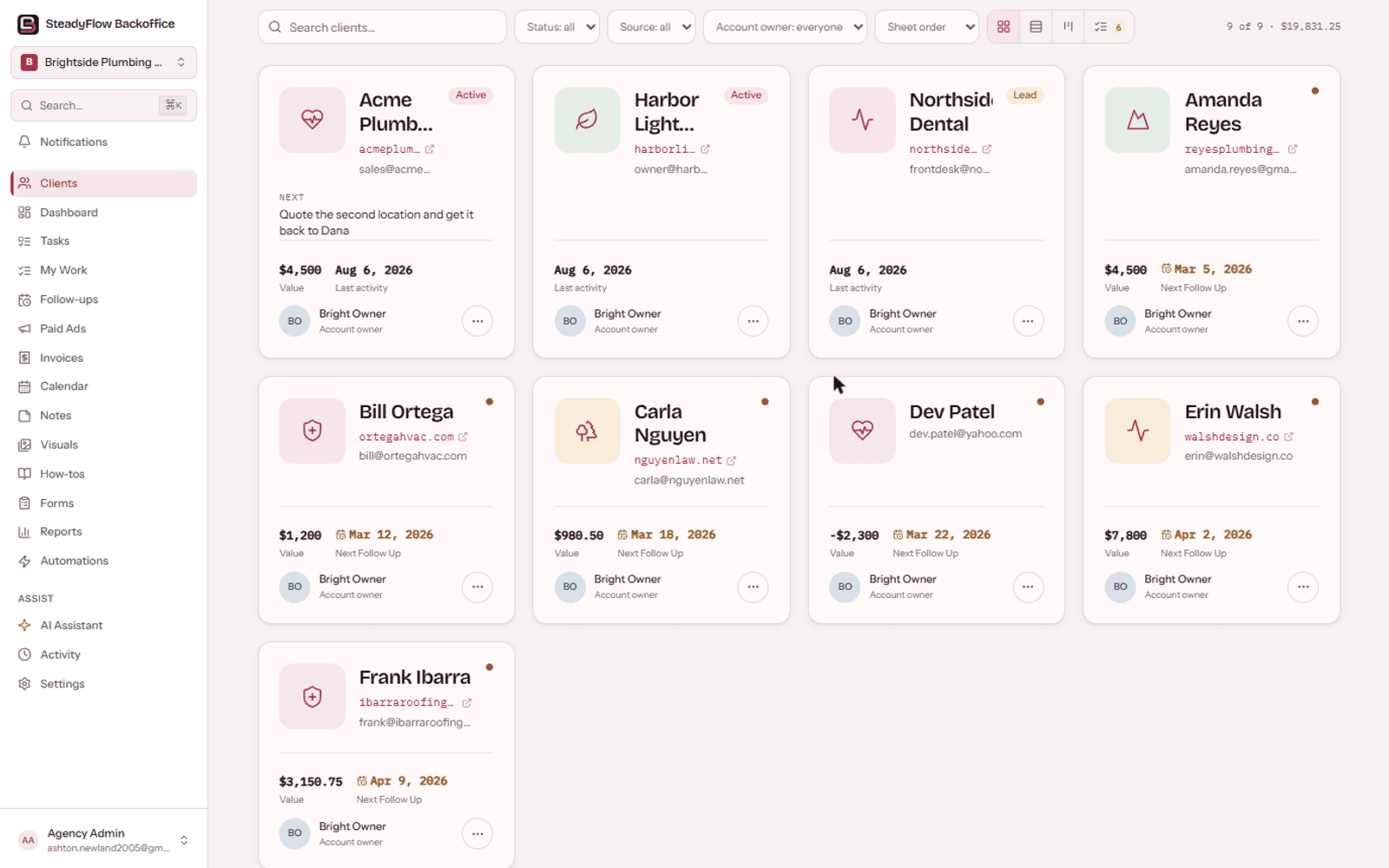
Every client you look after, on one page.

Clients is the front door. Cards, a list, or a board you drag across, with the numbers for the whole book above them. It is the answer to who we work for and what they are worth, without opening anything.

  • An account owner on every client, with a filter for your own accounts
  • The next action, its date, and what you are waiting on, right on the card
  • Group by business, mark new clients, archive the ones who have left
  • Logos, contacts, and the revenue line for the month, kept current
backoffice · Clients
SteadyFlow clients directory: client cards with status, value, account owner and the next action on each one
Everyone you work for, on one page, with who owns them and what happens next.
The client

A live document on every client, not a form.

Open a client and you land in something you write in. Post a dated update, tick a task off, record what was decided. It builds itself the first time you open it, and it is still there next quarter when somebody asks what you agreed.

  • Dated updates with templates for weekly notes, meetings, decisions and blockers
  • Checklists, callouts, tables and images, with drag-to-reorder
  • Contacts, files, links and ad spend in the rail beside the writing
  • Decisions and facts stored separately, so the AI treats them as binding
backoffice · Clients › Acme Plumbing Supply
A workspace client page: a live document with dated updates, tasks and decisions, alongside contacts and files
Every client gets a page. Updates, tasks and decisions live on it, not in your sent folder.
The triage

Needs review puts the drifting accounts at the top.

SteadyFlow watches the dates you already keep and works out which clients have gone quiet, which are blocked, and which nobody owns. Then it says so in a sentence rather than colouring in a score.

  • Worst first, with every reason written out in words
  • A count on the tab, so you know before you click
  • Healthy clients show nothing, so the few that matter stay visible
  • The thresholds are one edit away if it nags too much or too little
backoffice · Clients › Needs review
SteadyFlow Needs review queue listing clients worst first, each with the reason it was flagged written out
It tells you who needs you, and says why in words. No score to interpret.
The day

A task list that carries itself over.

Daily, weekly and monthly lists, shared with the team. Anything you leave unticked is still on tomorrow's list, marked with how long it has been waiting, so the list keeps being honest instead of quietly resetting.

  • Type at the bottom, press Enter. Sub-steps under any line
  • Carry-over is worked out, never rewritten, so looking back at Monday is accurate
  • Move an item to tomorrow, this week, or this month from one menu
backoffice · Tasks
SteadyFlow tasks page with daily, weekly and monthly lists and today's unticked items
Daily, weekly and monthly. Anything you do not finish carries over and says how long it has been waiting.
The pad

A scratchpad that leaves the browser.

The thought you have while reading an email should not need a tab. The pad pops out into a small always-on-top window that sits over Excel, Gmail, anything, and you file the jot to a client from inside it.

  • Pop out, then shrink it to a bar when you are done with it
  • Search every note and open one straight into the pad
  • Switch it to your task list without leaving what you were writing
  • Chrome and Edge, feature-detected, so it is simply absent elsewhere
backoffice · Scratchpad
The SteadyFlow scratchpad popped out into a small floating window, filed to a client, sitting on top of another app
The pad pops out of the browser and floats on top of everything else, so a note lands somewhere.
The AI

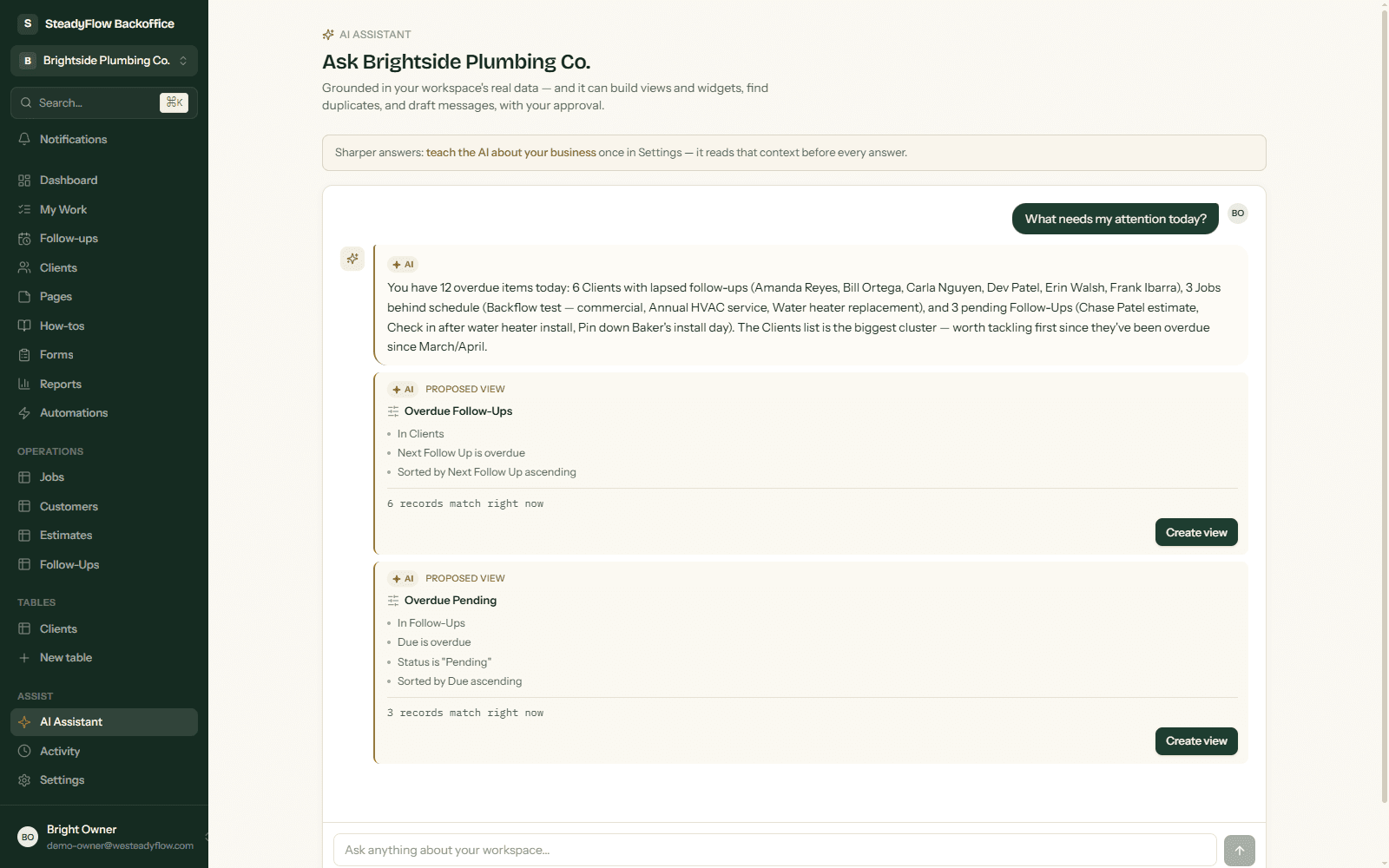
Ask your business anything. Approve what it builds.

The assistant answers from your records and your client pages, in gold so you always know what the AI wrote. When it proposes a view, a widget, or a cleanup, you see exactly what will change before it does.

  • Grounded answers: who went quiet, what is overdue, what changed this week
  • It reads through your permissions, so it can never answer about an account you cannot open
  • Proposals with previews: views, widgets, duplicate finding, drafts
  • Every request logged per workspace, with the model and duration visible
backoffice · AI Assistant
SteadyFlow AI assistant answering a question about client accounts and proposing changes for approval
Ask in plain language. Answers come from your real records, and you approve anything it builds.
The morning

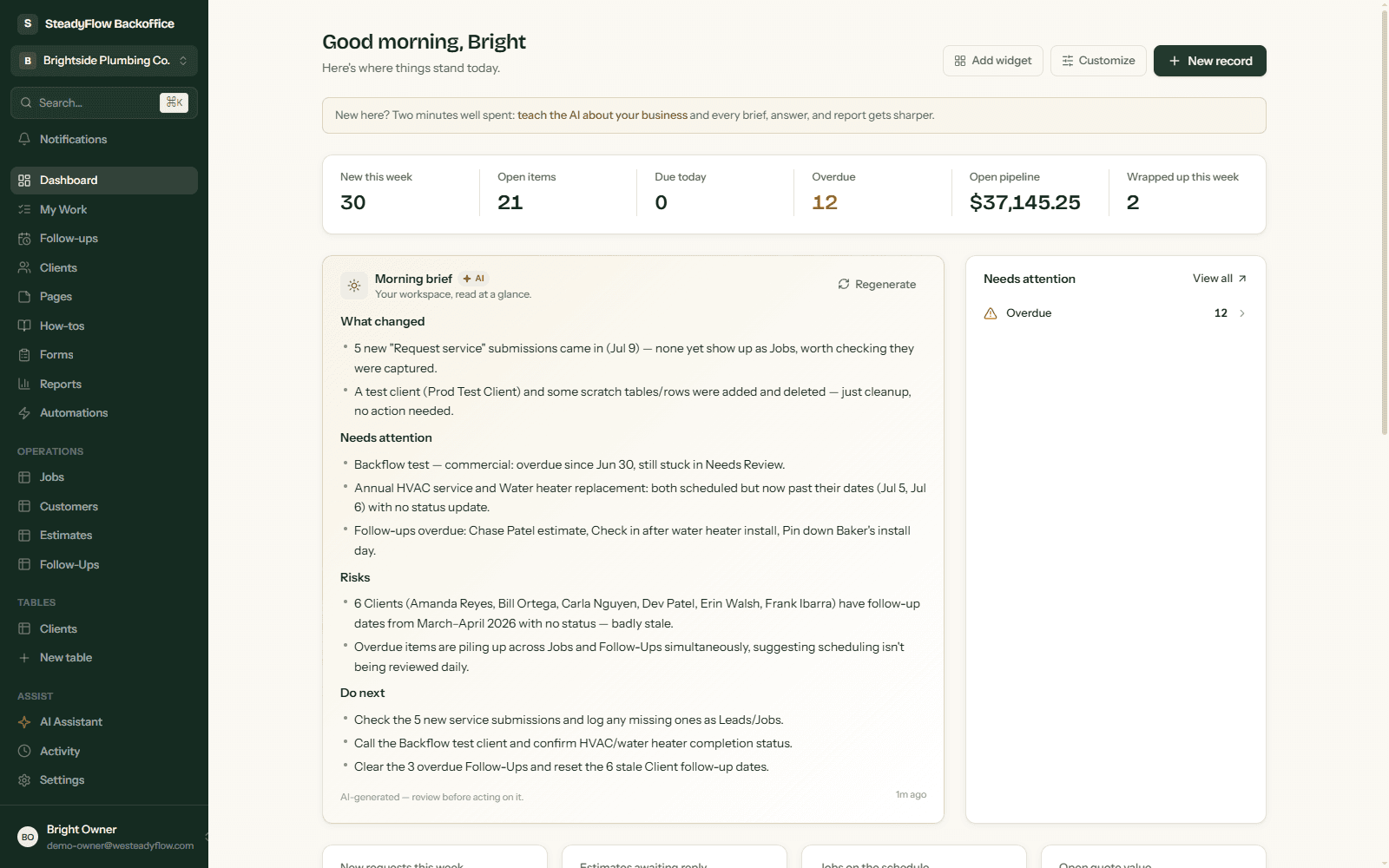
Open the dashboard and know where things stand.

The dashboard reads your whole workspace: live numbers, what is new, what is overdue, and an AI morning brief written from your actual records. Sections you do not want, you hide.

  • A needs-attention engine that finds overdue, stale, and urgent work by itself
  • Widgets you configure, or ask the AI to build for you
  • Six report presets plus a scheduled email digest for owners
backoffice · Dashboard
SteadyFlow owner dashboard with an AI morning brief, live numbers, and a needs-attention list
Your numbers, what needs attention, and an AI brief of the day.
The knowledge

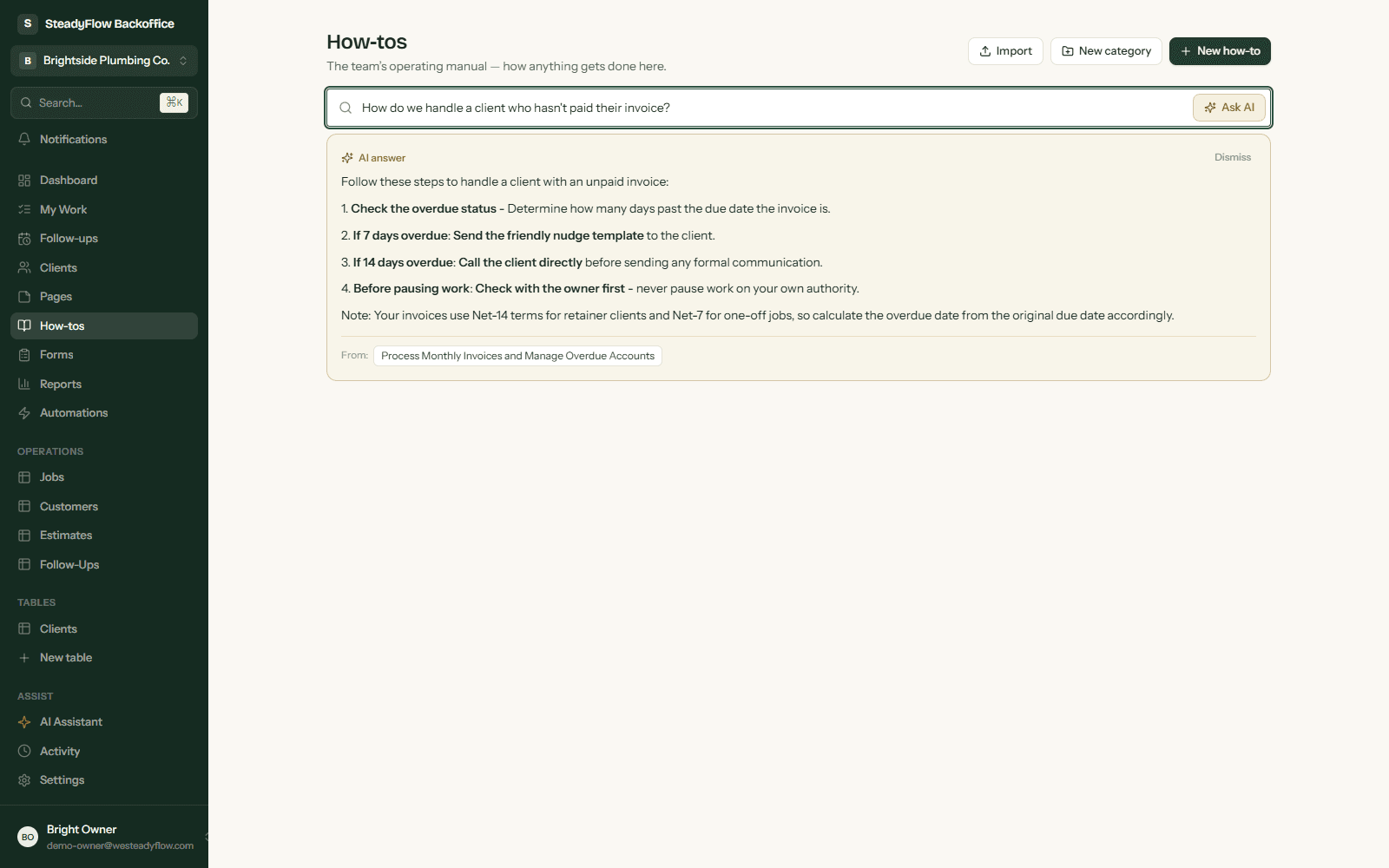
How-tos: your operating manual, searchable and alive.

The way things get done at your company usually lives in the owner's head. How-tos moves it into the workspace: import your existing docs and PDFs in bulk, organize with one AI pass, and let the team ask questions that get answered with sources.

  • Bulk import from Word, PDF, text, or paste
  • Ask how anything gets done and get steps with the source cited
  • The AI reads your how-tos when answering everywhere else, too
backoffice · How-tos
SteadyFlow How-tos knowledge base answering a question about unpaid invoices with a cited source
Your SOPs answer back: ask how anything gets done and get the steps, with the source cited.
The outside world

Portals give clients a calm page, not the inside of your business.

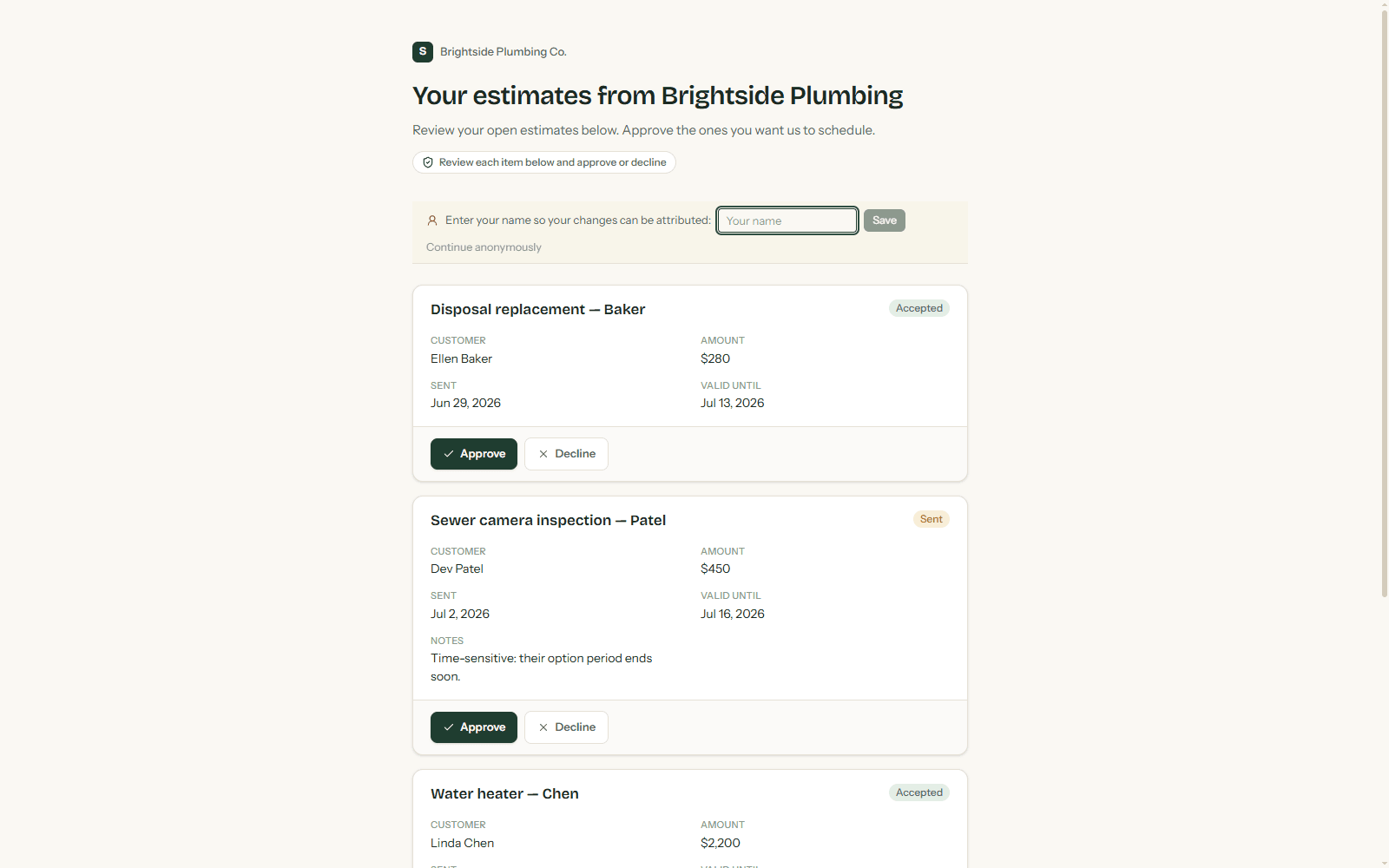
Share a scoped link and a client sees only what you chose: their estimates, their project, their files. They approve, decline, or upload without an account, and it all lands back in your workspace with a paper trail.

  • Quote approval from any phone, no login
  • Anything you hide is stripped server-side, it never reaches the client
  • Every link revocable at any time
backoffice · Client portal
Client portal page where a customer reviews estimates and approves or declines each one
Clients approve quotes from a simple link. No login, no app to install.
01 · Client added

Client enters SteadyFlow

The relationship starts with one client record: ownership, status, contact context, and the next meaningful action.

Context
02 · Needs attention

Something needs attention

The record surfaces where the relationship is starting to drift, without moving the issue into another disconnected system.

Work
03 · Task completed

The work moves forward

Tasks and commitments stay attached to the client record instead of disappearing into a separate task list.

Work
04 · Decision recorded

A decision becomes context

Updates, notes, and decisions become permanent context, so the next person does not have to reconstruct what happened.

Context
05 · Process moved

The process advances

The operating process moves forward while the history underneath it stays attached to the same client.

Work
06 · Report ready

Visibility becomes part of the record

Reports become another layer of the client story, connected to the work that created them.

Visibility
07 · Portal shared

The client gets the right view

Portal activity is another layer on the same relationship, not another place the team has to keep in sync.

Visibility
08 · AI brief ready

AI reads the whole history

Because work, context, and visibility live together, AI can summarize what changed, what matters, and what should happen next.

AI
One client · one continuous record

One relationship. Every moment connected.

Tasks, updates, decisions, reports, portals and AI are different kinds of work. They become layers of the same client history.

The plumbing

Everything a back office is supposed to have.

The unglamorous parts, because those are the ones you will care about in month six.

Paid ads

Google and Meta accounts per client, grouped by business, with cost and cost per click. Rows appear on their own for any client whose services mention ads, and linking a Google account pulls the numbers in nightly, read-only so a sync never fights a typed figure. One-page report, grouped by platform, ready to print.

Access levels

A relationship manager sees the accounts, the history, and the work, and no money at all. The figures are stripped on the server, not hidden in the page.

Per-person views

Each teammate gets only the tabs they need and lands on the page they work from. Set it per person, in one dialog.

Notes

Private to you by default. Share a note with the people you name, or the whole business, from the note itself. A note pinned to a client belongs to the client.

Forms

Public intake forms create records directly, with optional AI triage that summarizes and prioritizes each submission before your team sees it.

Automations

When a status changes, a follow-up comes due, or a form arrives, the workspace can flag records, log activity, run AI, or send an email. You define the rules once.

Webhooks

Anything that can send a POST request can create records: Zapier, Make, your website, your phone system.

Version history

Every change to every record is captured. See what changed, who changed it, and restore any value.

Export & backup

One click downloads everything: every record as CSV, plus your notes, forms, and automations. Your data stays yours.

Notifications

Assignments and mentions notify the right person, in the app or by email, on their schedule.

Calendar

Meetings, deadlines, tasks and days off on one shared calendar, colour-coded by kind.

How the setup works

Is the software not the whole answer? Some businesses need someone to come in, work out how the place actually runs, and build the missing pieces around it. That is the other half of what SteadyFlow does.

Work with Ashton directly
Tell me how your business works

Ready to run on a system instead of memory?

Tell me what you keep track of and where the work goes missing, and I will come back with what your workspace would look like. I reply personally, usually the same day.

I'm interested in

No pressure. No long-term contract. We reply personally.

Month-to-monthCancel anytimeNo lock-inWork directly with the builder
ashton@westeadyflow.com(719) 659-9858